.jpg)
Resources
You can find Incarnation sermons and recorded teachings below.
Recent Sermons
Sixteenth Sunday after Pentecost
9/13/26
Matthew 18:21-35
Fifteenth Sunday after Pentecost
9/6/26
Ezekiel 33:7-11
Fourteenth Sunday after Pentecost
8/30/26
Matthew 16:21-28
Thirteenth Sunday after Pentecost
Sermon by John Bryant
8/23/26
Matthew 16:13-20
Twelfth Sunday after Pentecost
8/16/26
Matthew 15:10-28
Eleventh Sunday after Pentecost
8/9/26
1 Kings 19:1-18
Tenth Sunday after Pentecost
8/2/26
Matthew 14:13-21
Ninth Sunday after Pentecost
7/26/26
Romans 8:26-39
Ancient Words and Bodily Worship:
Exploring the Episcopal Tradition
The Shape of Our Worship:
It's All About Showing Up
a homily on 2 Kings 5
Today we hear the story of an unlikely character. His name is Na’aman, and he’s not the kind of person you’d expect to read about in the Hebrew Scriptures. Why? Well for one, he’s not an Israelite—in fact he’s the commander of an opposing army, the army of Aram. He’s not a part of God’s covenant people. He does not worship the one true God. But on top of that, Na’aman is a leper. Leprosy in the Bible was a kind of catch-all name for various infections which disfigured the skin and were chronic in nature. They didn’t get better. They didn’t go away. In Israel, anyone determined to have leprosy was considered unclean—cut off from social privileges and cast out from the community of worship. Now, Na’aman was an Aramean, not a Jew, so he wasn’t under Torah law, but one can imagine that, no matter where you lived in the Ancient Near East, leprosy had to be among the most isolating and painful conditions. Lepers didn’t have the privilege of suffering in private. Their sickness was on perpetual display. The text tells us that one of the servants in Na’aman’s household happened to be an Israelite woman, who was taken in a previous Aramean raid. And for whatever reason this young woman, rather than hate her kidnappers, is concerned for Na’aman’s health. She wants him to be cured of his leprosy, and she has an idea of who could do it. Cue Elisha the prophet. Elisha is a strange, mysterious, intense figure in the Scriptures. Na’aman encounters Elisha early on in his prophetic ministry, but by the time we get to Na’aman’s story, Elisha has already multiplied jars of oil as if by magic, made a barren woman bear a son, and then raised that same child to life again after he dropped dead working in the fields. And apparently the news about Elisha has gotten around. It’s not surprising. I mean, this is flashy stuff. This is the kind of religion that draws a crowd. Signs and wonders. Loud words, bright lights, fire from heaven. So this Israelite servant that we meet in Aram decides to pull Na’aman’s wife aside and make a recommendation: Na’aman should go and see Elisha, the prophet of God in Israel. Now we don’t read these verses in our lectionary reading, but what follows is a something like a convoluted game of telephone—Na’aman’s wife passes on this recommendation to Na’aman, who tells his master, the king of Aram, who writes to the king of Israel. And the letter that at long last winds up in the hands of the Israelite king is, not surprisingly, a little garbled, as often happens in the game of telephone. “When this letter reaches you, know that I have sent to you Na’aman my servant, that you may cure him of leprosy.” Now the king of Israel has not been working any miracles lately, or ever, and he knows leprosy cannot be cured. His initial take on this letter is that it’s the provocation of another Aramean raid or attack. He’s upset. He’s terrified. But when Elisha hears about this letter, announcing Na’aman’s arrival and the expectation that the nation of Israel will somehow cure him, he steps in. “Let him come now to me,” he tells the king, “that he may know there is a prophet in Israel.” Wow. That’s confidence for you. Send him to me, Elisha says, and then he will know what he has never known before: that the Lord is God, that this God is at work, and that I am God’s prophet. So Na’aman goes, the Scriptures tell us. He arrives with all his pomp and circumstance, the commander of the Aramean army. He arrives with his horses and chariots. He arrives, so it seems, expecting signs and wonders, loud words, bright lights, fire from heaven—an act of God. But that’s not what happens. Instead, Elisha sends a messenger out to Na’aman, a nobody, unnamed in the story, and through this nobody messenger he tells Na’aman to go and wash his skin in the Jordan river, wash it seven times. From Na’aman’s reaction it’s clear that he thinks Elisha is messing with him, and he’s angry. I thought, for me, he would come out, and wave his hands, and call aloud upon the name of the Lord and cure me on the spot. I thought there would be loud words, bright lights, fire from heaven. Wash my skin? Leprosy isn’t cured by soap and water, Elisha. My suffering can’t be scrubbed away. The text doesn’t tell us this, but I imagine Na’aman spitting on Elisha’s doorstep as he turns and walks away, directing all his horses and chariots and accompaniment back home to Aram. Elisha, it turns out, is a fluke, a fake. And so must be his God. But his servants step in, at that moment, and they manage to convince him to give it a try. Why not? they say. You would have done whatever he told you if it had been hard and grueling, mystical, dramatic. Why not try just washing in the river? The Scriptures continue, “So he went down and dipped himself seven times in the Jordan, according to the word of the man of God, and his flesh was restored like the flesh of a little child, and he was clean.” When Na’aman set out from Aram with his horses and chariots, he expected signs and wonders, drama and fanfare, attention and bright lights. What he got was a thoroughly unexciting command, come through the mouth of a nobody messenger. And an act of God. He experienced an act of God. It can be easy to think of the life with of faith as a series of dramatic, exceptional moments. As human beings, we often go looking for signs and wonders, bright lights, fire from heaven. And don’t get me wrong, sometimes God does things that way. Sometimes God’s work is accompanied by a boom and a flash. But, as the Scriptures this morning remind us, God works in quieter ways too, and if we trust the witness of the Church throughout the ages, these quieter ways are not so much the exception as the rule. More often than not, God offers his saving love to us through means at once so ordinary and so strange that we may be tempted, as Na’aman was, to refuse the invitation that God holds out to us through them: through the waters of baptism, through bread and wine, through the ministry of nobody messengers, through the life and worship of the Church as a whole. Today we are taking a slow meander through the life and worship of the Church as this tradition has received it. This will not be an exhaustive exploration. We won’t cover everything there is to talk about. But our hope is to provide a vision for worship that has been set forth in Scripture and passed down through the Tradition of the Church. In this vision, worship is an exercise of trust. It’s about accepting the invitation God holds out to us. It’s about showing up—going to the waters, as Na’aman did—and encountering God’s life, God’s power, God’s salvation, in ways both quiet and profound. Showing up is an act of obedience and faith—that God will do what God has said he will do and be found in the places God has said he’ll be found. Showing up is also an act of praise. By our participation, by our showing up, we confess our need, and we declare that God is the one who can fill it. We confess our hunger and declare that God is the one who can feed us. We confess our sickness and declare that God is the one who can heal us. In other words, by showing up we call God, God. Today, we will begin with the waters of baptism, unfolding the bodily way that God draws us into union with himself and reflecting on the reality that the full conversion to Christ lasts our entire lives; we will meditate on the way we are met through the liturgy with the Gospel of Christ, continually turning our attention to the good news and liberating us to live in trust; we will explore the practice of anointing, whereby we continue in the life-long search for healing; and we will end by learning about, and celebrating the Holy Eucharist, receiving Christ’s own body and blood, God’s very life given for the life of the world. There won’t be loud words or bright lights; there probably won’t be fire from heaven—but make no mistake, friends, these are nothing less than acts of God. Amen.
Baptism and Confession:
Conversion Takes A Lifetime
If you were to walk into a traditional Episcopal church building, right inside the doorway, at the back of the church or perhaps at the back of a side chapel, you would find a baptismal font. This placement in relation to the rest of the church is on purpose. Baptism is our entrance into the Church’s life and worship. Why? Because the Church is Christ’s mystical body on earth, and to participate in that Body, we don’t merely fill out a form, or pay our dues, or do any of the things that we might associate with “membership” in the groups or clubs of the world. We become a member of the church, an organ of the Body of Christ, by way of a bodily act. Baptism with water in the name of the Triune God makes us members, organs, of Christ’s Body, and initiates us into this Body’s life and worship. Notice that this vision of baptism suggests that being incorporated into Christ’s body is not something that happens in our heads, or even in our hearts. Don’t get me wrong: God cares about our thinking and feeling, and God calls us to love him with all our hearts and all our souls and all our minds. In the Scriptures, baptism is always joined to faith, to conscious trust in God, and this conscious trust is needed to bring the relationship created in baptism to full maturity. But before we are thinking and feeling beings, we are incarnate beings—we are bodily creatures. What do I mean by this? Well, however you want to splice it, all my thoughts and feelings emerge from this mass of cells, this astonishing structure of matter that is my body. My body, in a sense, comes first—first I am cells, matter, muscle, and then, in time, I become conscious, able to feel, and eventually, able to think and reason and make judgements and so on, all because of the way God has arranged this mass of matter to work. And, in all likelihood, my body will carry on past when my brain can think clear thoughts, past when I can reason as I reason now, and perhaps even past conscious feeling. As Jamie Smith once said, “We are not brains on a stick.” On the contrary, we are, at our most fundamental level, matter. And this is not some secular idea, no, this is the image we are given in the Scriptures: we’re made from the dirt. And this is what we all have in common, old and young, unborn children and dying elders, those with vast active intellects and those with crippling disabilities. We are all of us bodies into whom God has breathed divine life. And as Christians we believe the Creator of Heaven and Earth decided that it should be this way, and reaffirmed this decision when the Word became flesh and dwelt among us not as a fully formed adult but as a mass of cells in Mary’s womb. Jesus was as much the saving Son of God then as when he hung on the cross, gasping out his love for us. In God’s creation, friends, the body comes first. And in light of this decision God made in creating the world this way, it’s fitting that God likewise chooses to bind us to Christ by our bodies. God claims this mass of cells; God marks this body as his own through the waters of baptism; God binds this body to Christ’s body through the power of the Spirit, who hovers over the baptismal waters just as the Spirit hovered over the waters at creation. And indeed, a new act of creation is taking place in baptism. We are being brought into Christ, and as St. Paul writes, “If anyone is in Christ, there is the new creation.” Over and over throughout the New Testament, when the early Christians were losing their way as a community, the apostles pointed to the concrete, objective, bodily fact that they have been baptized—that they have, by water and the Spirit, been bound to Christ in his death and resurrection. “Do you not know,” St. Paul writes in his letter to the Romans, “that all you who have been baptized into Christ Jesus have been baptized into his death? We were buried with him by baptism into death, in order that, just as Christ was raised from the dead by the glory of the Father, we too might walk in newness of life” (Rom 6:3-4). We are baptized into Christ. We are clothed with Christ through baptism. We are bound to Christ in his dying and rising through the baptismal waters. For this reason, St. Peter writes in his first letter to the Exiles that “baptism now saves us,” not because it’s magic, but because through baptism, God unites us to Christ, the one who has become our salvation. And yet, interestingly, St. Peter does not say, “Baptism has saved you”—past tense. Instead, he writes, “baptism now saves you,” saves you—is still saving you, is presently saving you. Our union with Christ is our salvation—but this is not the kind of milestone which, once reached, becomes a thing of the past. It is not the kind of thing that, once you do it, it’s done—like taking an entry exam or purchasing a ticket. This is a union that stretches on until it culminates in that perfected and eternal union that is everlasting life. As the great priest Austin Farrer once wrote, “Christ has taken us by the hand to lead us to himself.” That is one reason why you will rarely hear someone formed in this tradition talk about “when they were saved.” That’s not because we don’t believe in salvation! But if we think of salvation not merely as the rescue from sin but as the fullness of life in and with God and one another, then we certainly can’t talk it in the past tense. Salvation is a life-long project, which we work out, to use St. Paul words, “in fear and trembling”—or to say it another way, in the visceral awareness that we depend on God’s mercy from first to last. Conversion to Christ—the transfiguration of a fallen, warped, wounded human being into the image of perfect Love—takes a lifetime, well, more than a lifetime really. This transfiguration, this conversion, will only be complete when we see Love face to face, and all our bentness is undone, and all our wounds are healed. Baptism begins and sets the course of this journey. The Christian life is the baptized life. We live in and out of our baptism, our sacramental union with Jesus. We cling to our baptism as we live our lives, reminding ourselves day by day that we are bound to Christ and sealed with the Holy Spirit, and that through this union we are freed from the tyranny of self and restored to the liberty of love. This is why some churches keep their baptismal fonts open, holding water that has been blessed by a priest or bishop, even when there isn’t a baptism that day. Some people, and I am one of them, feel inclined to regularly mark their bodies with water in the sign of the cross as a physical reminder of their baptism—a reminder that God has claimed this body as his own, that God has bound me, this particular mass of cells, to Christ in his death and resurrection. And why does that matter? What does that mean? It means nothing can separate me from Jesus—no thought I think, no doubt I feel, no sin I struggle against, no horror or isolation or pain or sorrow that I experience. I am baptized. I am bound to Christ. And Christ will keep me until eternal life. But tomorrow is a Monday morning, as C.S. Lewis once wrote—figuratively speaking, I mean. And though I am baptized, I am still broken, as is the world I am limping through. Becoming whole will take more than my lifetime, as I said. And so the baptized life, the Christian life, is also the life of confession. You may notice that the confession of sin plays a prominent role in Episcopal worship. The prayer book orients us toward the confession of our sins morning and evening, day after day, and the service of Holy Eucharist pivots around the confession and absolution of sin, which we’ll talk more about later. But for now I will pose the question, why are we always confessing our sins? Why does this take so prominent a place in our worship? Well friends, in baptism we receive the forgiveness of sins because we receive Christ Jesus, who is our forgiveness. Bound to Christ in his death and resurrection, we return to God in perfect love. Our sins are forgiven, now and forever, through this union—but as we know from experience, sin is still in us, and as one priest writes it, “We are constantly falling away from the new life we have received in Christ.” The corporate confession in the Prayer Book which we prayed this morning and will pray again before we leave today suggests that sin has a particular shape. It’s more than a series of misdeeds. Certainly it includes the things we have done and left undone, but it is, at its core, a failure of love. “We have not loved you with our whole heart,” we confess to God. “We have not loved our neighbors as ourselves.” Some streams of Christianity teach that, if you were truly following Christ, you would have no need to confess your sins because you’d have no sins to confess. In our tradition, we uphold the opposite: It is our union with Christ that makes it possible to see, with ever-increasing clarity, the way our hearts turn from God and God’s mission, the way our love falters in the face of fear or pain or selfishness or anger or pride or greed or fill in the blank. The same priest writes it this way: “It is after baptism, and because of it, that the reality of sin can be recognized in all its sadness, and true repentance becomes possible.” Interestingly, though the confession of sin takes such a prominent place in our worship, I have not seen in the Episcopal Church what I have sometimes seen elsewhere in contemporary Christian circles: a tendency toward self-loathing and what we might call spiritual self-harm. And I think there’s good reason for that: in historical Christianity, the confession of sin is a corporate and public and regular act. Though we offer opportunities for private confession for those who desire to confess and receive absolution on a more personal level, it isn’t as if certain people only say the confession of sin. It’s not as if only certain sins count. On the contrary, together, all of us, as one body, confess that we have sinned against God. Together we acknowledge the sickness and selfishness of our thoughts, words, and deeds—and those of the wider Church, who may or may not be joining us in confession. Together we ask for forgiveness for our failure to love. And together, we receive the immediate, unqualified absolution—spoken by the priest, but understood to be the effectual declaration of God’s forgiveness, God’s unending mercy meeting us with haste. I’ve often pictured the confession of sin as the moment in the parable of the prodigal son where the son, who has left home and dishonored his family and squandered his inheritance, turns toward home. And what happens? The Father sees him from far off and comes running. So it is with confession and absolution: God comes running. God’s mercy meets us with haste. God’s forgiveness is ours before we make a quarter turn his direction. Thanks be to God. In sum, friends, we who constantly leave Jesus must constantly return to him. Confession is that return. Confession is the power of baptism alive in the Church, enabling us, empowering us by our union with Christ Jesus to see the sorrow of sin, and again and again to turn from it, and to turn toward God. We confess our sins, as one priest once said, “to receive again and again the gift which in Christ has been given once and for all.” This is a theme we will encounter more than once today: that the life of faith is truly a lifetime of faith. Salvation is not a one-and-done event, nor is reconciliation, coming to faith, healing, believing the Gospel, receiving Christ’s life. These needs are ongoing, perpetual, until we reach their culmination and completion in eternal life. Today this baptismal font will be open for any who wish to remind themselves of their baptism by the simple marking of one’s body with holy water. We are bound to Christ and marked as Christ’s own forever, and when we fall away, which we do again and again, the way back is as easy as turning to face the one who has been with us the whole time. Amen.
The Practice of Anointing:
Seeking to be Cured (Not Merely Healed)
reflection by Shirley Kilpatrick
We follow Jesus the Messiah, that is, Jesus the Anointed One. Recall what happened at Jesus’ baptism: “heaven was opened and the Holy Spirit descended on him in the bodily form of a dove. And a voice came from heaven: ‘You are my Son, whom I love; and with you I am well pleased’” (Luke 3:22). As we learn from other passages of Scripture, Jesus receives not only the baptism of water John the Baptist is able to provide, he also receives an anointing, given by the Holy Spirit, in the will of the Father. We notice that both the water and the dove are bodily experiences. The anointing isn’t something that just happened “in Jesus’ head”. In Luke 4, Jesus, in the synagogue, reads from the book of Isaiah. He is well aware of his anointing as he reads: “The Spirit of the Lord is upon me, because he has anointed me to bring good news to the poor. He has sent me to proclaim release to the captives and recovery of sight to the blind, to set free those who are oppressed, to proclaim the year of the Lord’s favor.” When he finishes reading, Jesus says, “Today this scripture is fulfilled in your hearing.” When called to the house of Cornelius, a Gentile, the Apostle Peter reviews the anointing of Jesus: “You know what has happened throughout Judea, beginning in Galilee after the baptism that John preached—how God anointed Jesus of Nazareth with the Holy Spirit and power, and how he went around doing good and healing all who were under the power of the devil, because God was with him” (Acts 10). The Apostle John explains how urgent it is that we understand our anointing in Christ, especially in the face of false teaching: "I write this to you about those who would deceive you; but the anointing which you received from him abides in you . . ." (1 John 2:26-27a). So, Jesus, in His baptism, is anointed with the Holy Spirit and power; similarly, in our baptism we become anointed ones. The baptismal liturgy says, “You are sealed with the Holy Spirit and marked as Christ’s own forever.” Because this is true, no one who is baptized MUST receive another anointing. While none of us MUST receive another anointing, all of us MAY be candidates for physical anointing. Episcopalians affirm two gospel sacraments: baptism and the Holy Eucharist. In other words, Christ Jesus himself commanded these gospel sacraments. We are to understand them to be an essential means of participation in Christ’s life. Though it is a means of grace, anointing is not a gospel sacrament. It is a sacramental rite. That is, along with a rite like holy matrimony, it is optional. Not all Christians must marry! All Christians MAY marry. Some SHOULD marry. But none MUST marry. So it is with anointing. There is much regarding anointing we could study in the Old Testament. For example, we could look at the anointing of priests and kings which set them apart for the roles they were to play in the life of God’s people, Israel. In like manner we anoint priests and deacons today, setting them apart for their roles in the church. But for today we will turn to the New Testament. What does the New Testament say? The primary text in the New Testament is found in James 5:14: "Are any among you sick? They should call for the elders of the church and have them pray over them, anointing them with oil in the name of the Lord." We notice a few things here: We may be anointed when we are near death, what has historically been known as Extreme Unction, “unction” meaning “anointing.” But the scripture does not, in fact, specify how sick we must be or in what way we must be sick to qualify for anointing. The catechism says that anointing of the sick with oil “is given for the healing of spirit, mind, and body” (BCP 861). How should we think about the healing described here? We see that the Episcopalian view of healing is expansive rather than restrictive. Until the advent of the 1979 prayer book, Episcopalians acknowledged in confession that “there is no health in us.” Perhaps the authors of the 1979 prayer book thought that phrase might be confusing for modern worshippers, but previous generations of believers knew what it meant. “Health” meant “wholeness.” And wholeness was precisely what we could not attain on our own. The Apostle Paul makes it abundantly clear that we have no adequate strength or power to heal our sin, sorrow, decay, and death. Neither can we successfully do the good work we set out to do. It’s helpful to turn to St. Augustine, a theologian and bishop from 400 A.D. In his book, Confessions, he says to the Lord, “in you, I pray that what is scattered in me may be brought together, so that no part of me may be apart from you. Sometimes when you are working within me, bringing my scattered self to you, you draw me into a state of feeling that is unlike anything I am used to, a kind of sweet delight. I know that if this spiritual state were made permanent in me it would be something not of this world, not of this life” (C 10). Augustine knows that the Lord is always working in him, drawing him into wholeness, but sometimes the Lord helps Augustine to be more consciously aware of this divine operation. These are such encouraging moments. The feeling is not now permanent, but when the wholeness is permanent, the delight will be too. Augustine knows that would be something truly out of this world, a new life. So, while none of us MUST receive ritual anointing, each of us MAY as we seek for true health and strength, the sweet delight we need to persevere to the end. The catechism asks, “How are the sacraments related to our Christian hope?” The answer: “Sacraments sustain our present hope and anticipate its future fulfillment.” As one of my clergy friends has said, anointing is a tangible depiction of the Holy Spirit’s activity in our lives. It can help us to believe once again that “He who has begun a good work in us will bring it to completion at the day of Jesus Christ” (Phil. 1:6). What will happen if we choose to receive anointing? Deanna will extend such an invitation to us today. When it is my turn, I will take my place in front of her. I will stand immediately in front of her so that she can lay her hand on my head or shoulder. She may ask me why I have come forward for anointing. If she does, I will say just a few words of explanation. Then she will anoint me with oil, making a cross with her thumb on my forehead. Sometimes priests will repeat that action on both palms. I always put my palms up in an attitude of prayer so that this action can happen. Along with this physical anointing, Deanna will ask a blessing. She may pray a spontaneous prayer, responding to what I have said, but she will certainly also draw from the Prayer Book for a blessing. The prayer book provides a number of prayers for this moment. I have chosen one of the longer ones which helps us to hear what the Episcopal tradition believes is possible in this sacramental rite: As you are outwardly anointed with this holy oil, so may our heavenly Father grant you the inward anointing of the Holy Spirit. Of his great mercy, may he forgive your sins, release you from suffering, and restore you to wholeness and strength. May he deliver you from all evil, preserve you in all goodness and bring you to everlasting life; through Jesus Christ our Lord. Amen. (BCP 456) St. Stephen’s Episcopal Church of Witchita, Kansas, posts this explanation on its website: This sacrament[al rite] exists for the purpose of healing -- to restore a person to physical, emotional and spiritual wholeness. When we anoint and pray for people, we ask God to release them from anything that prevents a person from being whole. Christians recognize that there is a difference between being healed and being cured. In the sacrament of Unction, we pray for healing and wholeness, which may or may not include a physical cure. Augustine takes us to Psalm 103:2, 3: Bless the Lord, O my soul, and do not forget all his benefits— who forgives all your iniquity, who heals all your diseases, In his exposition of this passage, Augustine says that at our baptism, the Lord pulled the spear from us, saving us from a mortal wound. The fever has broken, but we need healing from the debilitating effects of the original wound. The Lord has forgiven our sin, but more than that, he is healing all our brokenness, strengthening us, transforming us into his likeness. We may have specific matters which move us to seek ritual anointing, but such a specific matter is not required to receive anointing, because we all need this ongoing, unfolding healing. To sum up, all baptized believers have been forgiven and anointed with the Holy Spirit. But we will spend our entire lives undergoing the thorough healing we need. The Scriptures show us that healing can happen in a wide variety of ways, but Episcopalians believe that ritual anointing is one of the ways. We are free to come. The Isaiah passage which Jesus read in the synagogue includes precious promises: the Lord has come to comfort all who mourn, and provide for those who grieve in Zion— to bestow on them a crown of beauty instead of ashes, the oil of joy instead of mourning, and a garment of praise instead of a spirit of despair.
Procession, Acclamation, and Opening Prayers:
Entering A Different Kingdom
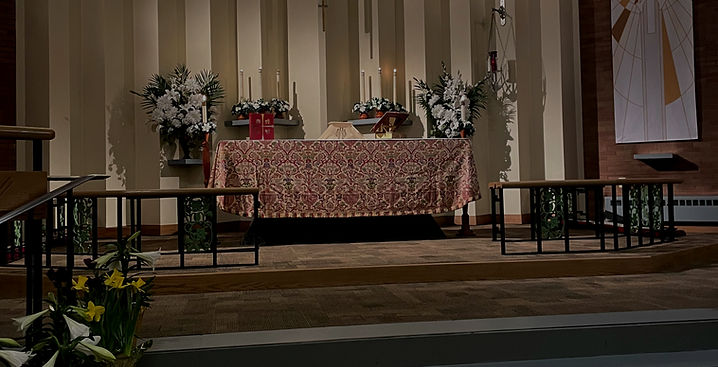
Our worship begins as we gather, each from our own homes, our own lives, the stress of the past week, the bustle of the morning, whatever sorrow or joy or weariness or wonder we are carrying. We bring our lives with us into the Church, and at the same time, we step into a space that has been consecrated for a holy purpose: the worship of the Triune God. Of course, all the world is the Lord’s, and God meets us everywhere. But as the Church gathers on a Sunday morning for Holy Eucharist, we are, in a way, entering a different Kingdom—the Kingdom in which God is blessed, the Kingdom in which Christ’s Body is constituted, literally formed anew, through our worship. This other Kingdom that we enter as we gather in the name of the Lord is truly other: though made up of those who are in the world and who have been formed in the world, this Kingdom doesn’t look the world, talk like the world, move like the world, assume the world’s logic or social order or fashion or systems. This Kingdom, the heavenly Kingdom that is breaking through into our midst and that we are entering by showing up, follows different rules. Instead of a friendly exchange of “Good mornings” to begin our worship, we greet each other with the words that set this Kingdom apart: “Blessed be God, Father, Son, and Holy Spirit,” the priest says to the people, to which the people reply, “And blessed be his Kingdom now and forever.” Earthly kingdoms have their own “blessed bes”: blessed be money, blessed be political dominance, blessed be my own privilege, blessed be security, blessed be the nuclear family—and you can, I’m sure, come up with others. But now the people of God are coming together to constitute the eternal Kingdom, the heavenly Kingdom, in which God and God alone is blessed. This Kingdom has broken into ordinary life, into our harried mornings, into our long work weeks, and we have become this Kingdom by showing up. We are embodying the inbreaking Kingdom by way of our liturgy. In this inbreaking Kingdom, we do not measure time by the earth’s revolution around the sun, as we would using the twelve-month calendar we’re all familiar with. Instead, we mark the seasons by the unfolding revelation of God in Christ: Advent, Christmas, Epiphany, Lent, Easter, Pentecost. We rehearse and remind ourselves of the truth of who God is and who we are as we move through the year. In this inbreaking Kingdom, the priest, who facilitates our worship, is only a minister, an unnamed nobody, just like we heard about in Na’aman’s story this morning—not the focal point, not the star of the show. Christ is our high priest, and Christ is the one who meets us in this Kingdom. For this reason, priests and other ministers wear vestments during worship. Vestments are, first of all, an equalizer; they cover up status and wealth and personality, so that as the priest I am not tempted to turn worship into a stage, and you, as God’s people, are not subject to such a display. And, on the other hand, vestments serve to beautify our worship, to lift it up, to reveal the otherworldliness of what we are doing. They “veil” the minister so that Christ may be revealed, and they “unveil” the heavenly Kingdom, which is breaking into time through our liturgy. In this inbreaking Kingdom, we present our selves, our souls and our bodies, to God. We do not worship as brains on a stick. We worship as creatures, soul and body both. Many people will engage in bodily forms of devotion throughout the service. We may bow in reverence to Christ as the cross passes by us, or as we approach the altar on which Christ makes himself known to us. We may mark ourselves with the sign of the cross, the sign of Christ’s victory, at various points throughout the service. We may kneel to confess our sins, and stand to declare God’s peace and God’s praise. These bodily acts of devotion are not mandatory. You can do what feels comfortable to you. They are simply an invitation. All that we’re doing here is an invitation, in fact. An invitation to show up in trust and move deeper into life with God. So we begin.
The Liturgy of the Word:
God Speaks and We Respond
In the inbreaking Kingdom, in the heavenly Kingdom, God always speaks first. The shape of our Eucharistic liturgy follows the story of Christ and his disciples that we find in Luke 24. A pair of disciples are journeying from Jerusalem to Emmaus after the crucifixion, and the crucified and risen Jesus draws near and walks with them, but they don’t recognize him. He asks what they are talking about, and in response, the narrator tells us, “they stood still, looking sad” (v. 17). If you’re familiar with the story, you know that after allowing them to express their dismay over all that has taken place, Jesus opens the Scriptures to them, proclaiming his own life and person through the Scriptures of Israel. Later, while he was at table with them, “he took the bread and blessed and broke it and gave it to them” (v. 30). The Scriptures describe the disciples’ response to this sacramental act: Their eyes were opened, and they recognized him. And he vanished from their sight. They said to each other, “Did not our hearts burn within us while he talked to us on the road, while he opened to us the Scriptures?” …[Later, they told the other disciples] what had happened on the road, and how he was known to them in the breaking of the bread. Jesus opens the Scriptures, reveals his own person and life through them, and then offers his very self to his disciples in the breaking of the bread. Such is the pattern of Eucharistic worship. The Liturgy of the Word includes readings from what we call the lectionary, which is a schedule of assigned passages that move us through the majority of Scripture over a three-year cycle. Many Christians follow this same lectionary, which means across several denominations, and even across Protestants and Catholics, Christians all over the world are meditating on the same Scriptures on the same morning. The reading of the Gospel is treated with particularity in the liturgy. We stand for the Gospel reading to indicate the unique significance of Christ’s incarnate life in God’s plan of salvation. Typically, a minister will process behind the cross with the Gospel book, signifying the Word of God coming among us in the flesh. When the Gospel is announced, many people will sign the cross on their forehead, lips, and chest, praying a physical prayer that the good news of God in Christ would be ever on their minds, on their lips, and in their hearts. After the Scriptures are read, the Word is preached. In the Episcopal tradition, preaching is not teaching. It is not the place for a lecture or an academic breakdown of the text. Preaching is the proclamation of the Good News of God in Christ from the Scriptures. It is a proclamation of the living Word, who is none other than Jesus, and through this proclamation, Jesus himself draws near to us as he did with the disciples on the road to Emmaus, making our hearts burn within us, bringing comfort to the sorrowing, strength the weak, hope to the despairing, courage to the fearful, life to the dead. To borrow an image from another Episcopal writer and theologian, preaching is not about “teaching the teachable or reforming the reformable or improving the improvable; it is about raising the dead.” In response to this proclamation, in response to Christ coming among us as the living Word, we stand and confess the creed, declaring our faith and trust in this Word. Confessing the Creed isn’t an expression of spiritual feeling. It’s an assertion of the truth about who God is. And we embody this assertion by standing to confess the Creed. We are, literally and figuratively, taking a stand. The reason this stand is necessary is because our confession takes place in a fallen world—a world that has rejected God, spurned his commandments, and murdered his Messiah, and we are part of that world, and that world is in us. By confessing the Creed, we declare our loyalty to the inbreaking Kingdom, God’s Kingdom. We take sides in the ongoing war that plays out in the heart of every human being. In a world that is forever looking to make earthly rulers into messiahs, we declare that we believe in One God and One Lord. In a world that would have us believe that power culminates in the exercise of force, we declare that the Almighty and All-Powerful One died on a criminal’s cross and descended to the dead as his climactic act of power. In a world that would have us believe that death and darkness have the final word, we declare that we believe in resurrection, the forgiveness of sins, and life everlasting. In the liturgy of the Word, God speaks the Word of life, and God’s people, newly animated by this Word, respond in faith, taking our stand with the crucified and risen Jesus.
Prayers, Confession, Absolution, and the Passing of the Peace:
The Peace of Christ Reigns
At this point, we enter a portion of the service in which we bring all our needs to God: first in prayer for the world and the Church, and then in the confession of sin. In the inbreaking Kingdom, we reject all claims to self-sufficiency. We know ourselves to be in need and we come with our needs to God. The prayers of the people are intended to gather the needs of the world, the Church, and our local community, and bring them corporately to the throne of grace. We may not think to pray for each of these things on our own. These prayers form us in habits of attentiveness to the true needs of the world. Some churches will offer the prayers of the people from a kneeler in the center aisle, signifying that these are, truly, the prayers of this people, emerging from among us. There are several forms for the prayers of the people in the Prayer Book, but in each form, there is a period in which we are invited to add our own petitions and thanksgivings, either aloud or in silence. Some congregations have a culture in which people may offer a brief prayer out loud during this time. Other congregations are more reserved. At Incarnation, we welcome you to offer your own prayers either aloud or in silence at this point in the liturgy, and we will intentionally provide space for you to do so. We then move into the confession of sin, which we talked about earlier. In the confession of sin, we acknowledge that we are not yet whole, as Shirley reminded us in her reflection on anointing. We acknowledge our sickness. We acknowledge how we fall short of God’s call to perfect love. We take responsibility for our sins and ask God’s forgiveness. At that point, the priest, representing Christ, stands and in God’s name pronounces absolution, or forgiveness, over the congregation, making the sign of the cross, God’s victory over sin, as a visible declaration to accompany these words. And it is with God’s forgiveness still ringing in our ears, that we stand to hear the proclamation of Christ’s peace, and to exchange Christ’s peace with one another. Ending this portion of the liturgy with the proclamation of Christ’s peace is a powerful embodiment of the truth that we believe. We are declaring that amidst all our needs, amidst all our sorrow and sickness and sin, Christ’s peace reigns among us and between us and within us.
Making Eucharist:
Receiving and Becoming Christ's Body
We now move into the final portion and the climax of our liturgy, the act of making Eucharist. This part of our worship begins with the offertory. An offering plate is passed around, and people can choose to give of their money to the Church, as an offering to the growth of God’s Kingdom. While the offering plate is being passed around, someone from the congregation will bring forward the bread and the wine that will be consecrated to become for us Christ’s Body and Blood. This is not a separate action from the offertory; it is a part of it. Admittedly, this is easier to grasp when we are the ones who grow the wheat and grapes ourselves, as was often the case in early Christianity. But even when we buy the bread from a church supply store and the wine from Fine Wine and Good Spirits, still, this is part of our offering. We are giving back to God what God has first given us: the fruit of our labor, our money, our resources, our time. And as we bring forward these gifts, we praise God from whom all blessings flow. This, naturally, leads us to what we call the Great Thanksgiving. You may know that the word Eucharist means thanksgiving. And the act of making Eucharist is the act of giving thanks for all of God’s gifts, and particularly for the unparalleled gift of God’s life in Christ. But the way in which this “Great Thanksgiving” starts is very important. “The Lord be with you,” the priest says. “And also with you,” the people reply. “Lift up your hearts.” “We lift them to the Lord.” Here we draw explicit attention to what we, as the Church, are doing. We are following Christ in his ascension. With Christ and in his name, we’ve lifted our hearts to the heavenly realm, to that other Kingdom that, from the moment we got out of bed this morning, we have been seeking. Here we stand before God in the presence of angels and archangels and the saints in light. Here we are invited to participate in the heavenly banquet. And as we stand here before God at his table in the heavenly Kingdom, in this mystical reality we’ve been invited into, what else can we do but give thanks, make Eucharist. “Let us give thanks to the Lord our God,” the priest says, and the people respond, “It is right to give him thanks and praise.” The priest goes on to emphasize the rightness of this thanksgiving, that it is truly the only fitting response to the glorious gifts that God gives us in Christ. And this act, this outpouring of thanksgiving, leads us to join our voices with all the angels and archangels and all the company of heaven around us, who, as Revelation reveals, are forever singing “Holy, Holy, Holy” before the throne of God. We join in a song that is already being sung. We lift our voices to magnify God with the heavenly choir. And what happens next? The priest and theologian Alexander Schmemann describes it this way: As we stand before God, remembering all that he has done for us, and offering him our thanksgiving for all his benefits, we inescapably discover that the content of all this thanksgiving and remembrance is Christ…. All thanksgiving is finally thanksgiving for Christ…. There is nothing else to remember, nothing else to be thankful for, [not because we have no other blessings, but] because in Christ every [blessing] finds its being, its life, its end. And so the Sanctus, [the ‘Holy, Holy, Holy,’] brings us so simply, so logically to that one man, [that] one night, [that] one event in which this world found once for all its judgement and its salvation. And so the liturgy continues, “On the night before he died for us, our Lord Jesus Christ took bread.” In obedience to Christ’s command to do this in remembrance of him, we tell the story of that last supper again and again, and yet in telling it we are not merely remembering. We are present at Christ’s table in the heavenly kingdom, receiving Christ’s life from Christ’s own hands. In the Episcopal Church, we believe that we partake of Christ’s real presence in the Eucharist, just as we truly die with him in baptism. Now, we don’t get into the details of how this works—we don’t uphold, for instance, the doctrine of transubstantiation, which suggests that the bread and wine cease to be bread and wine and become literal flesh and blood. In our tradition, we simply trust Christ’s promise that he will feed us with his very life through this meal, and we leave the details of the matter to God. In the Eucharistic feast, as we partake of Christ’s body and blood, we become again what our baptism has made us: we become the Body of Christ. And it is as Christ’s Body, filled with Christ’s very life, that we are sent out, back into the kingdoms of this earth, to love and serve the world in Christ’s name and to make God’s Kingdom present wherever we go. Amen.
How Did We Get Here?
a 6-week series on the Church
Week 1 - The Church is a Mess: Where Do We Start?
Week 2 - Apostles on a Mission: The Emergence of "the Church"
Week 3 - Preserving the Faith Until Christ Returns: The Formation of Tradition
Week 4 - When Schism Turns Noble: From Division as Grief to Division as Glory
Week 5 - The Chaos of Contemporary Christianity
Week 6 - Where Do We Go From Here? Seeking Safe Harbor